
A rare case of malignant efferent loop obstruction managed with endoscopic luminal self-expanding metal stenting, followed by an unusual mechanical afferent loop complication.

Both afferent and efferent loop syndromes are rare complications that can develop post-gastro-jejunostomy. Although the incidence of afferent loop syndrome is ~0.3% to 1%, efferent loop syndrome is extremely rare with only limited case reports. We report a case of malignant efferent loop obstruction which was successfully managed by an endoscopic luminal self-expanding metal stent. This led to an unusual complication of obstructive jaundice with cholangitis secondary to a mechanical afferent loop syndrome requiring an additional endoscopic luminal stenting of the afferent loop. Endoscopic management of afferent or efferent loop syndromes is technically challenging and a consecutive occurrence of the dual-loop syndromes should be expected by the interventional endoscopist.
Efferent loop syndrome (ELS) is a very rare complication following Billroth II type of gastro-jejunostomy surgery. The occurrence of ELS post-surgery can be divided into early or late causes, early causes of ELS can be due to internal hernias and intestinal kinking while late causes can be secondary to adhesions, strictures, or malignancy recurrence.
Clinical presentation of ELS is similar to afferent loop syndrome (ALS) as both conditions present with features of proximal small bowel obstruction. Endoscopic management options for ELS include the use of luminal self-expanding metal stents (SEMS), plastic double pigtail or naso-jejunal tube stents.
The most common complications following endotherapy are SEMS blockage due to tumor ingrowth, migration of luminal SEMS, rarely tumor over-growth, and intestinal mucosal prolapse. We report a rare complication of cholangitis due to a mechanical obstruction of the afferent loop caused by the SEMS which was placed for treating a malignant ELS.
A 45-year-old female with a prior history of distal gastrectomy with Billroth II type of gastro-jejunostomy surgery performed for distal gastric cancer presented to us with progressive postprandial fullness, recurrent vomiting, decreased appetite and weight loss. On clinical examination, she was dehydrated with tachycardia of 110 beats/minute and normal blood pressure. Abdominal examination revealed a non-tender, mildly distended upper abdomen with sluggish bowel sounds.
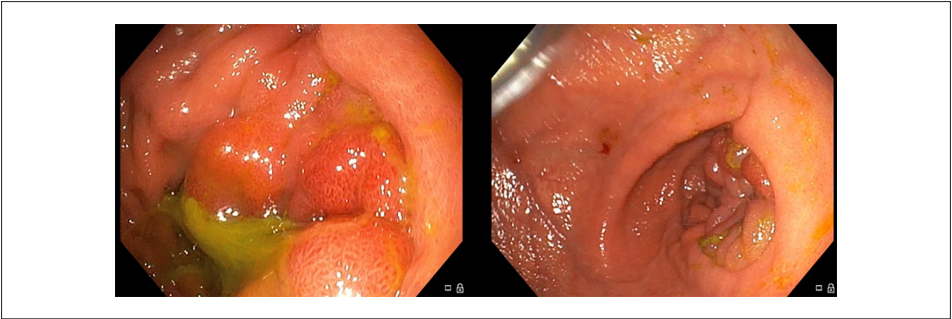
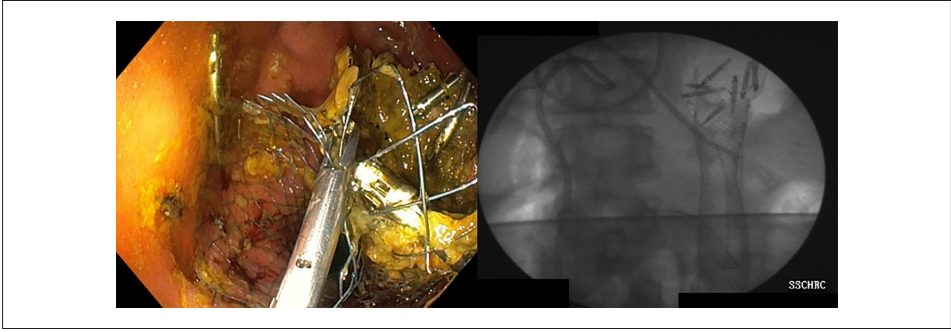
A diagnostic endoscopy showed luminal narrowing of the efferent loop due to mucosal edema with nodularity possibly due to tumor recurrence, the gastroscope could not be passed across the luminal obstruction (Figure 1). A positron emission tomography (PET) scan demonstrated significant thickening at the gastro-jejunostomy with an elevated F-fluorodeoxyglucose (FDG) activity along with extra-gastric sites suggestive of tumoral recurrence with metastases.
After a multidisciplinary team (MDT) meeting, a decision to treat the malignant ELS with luminal SEMS as a palliative intent was considered. After a detailed explanation of the procedure, and risks including complications, verbal, and written consent was obtained from the patient for the luminal SEMS procedure.
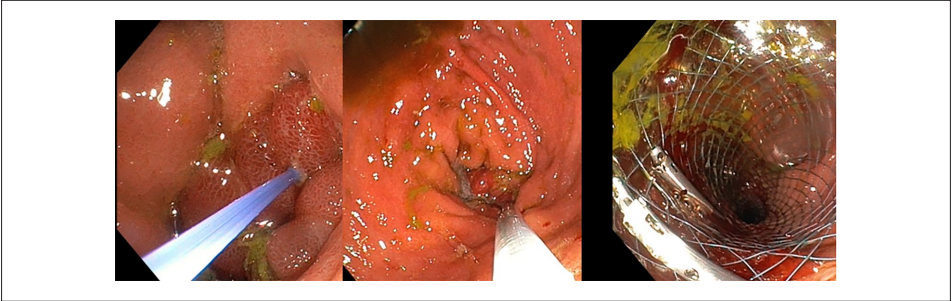
An over-guide-wire 2.2 × 12 cm Wall flex (Boston Scientific) uncovered duodenal SEMS was successfully placed across the efferent loop obstruction under endoscopic and fluoro-guidance (Figure 2). The patient was clinically improved and was tolerating oral diet, hence was discharged.
Four weeks post-procedure she consulted a general physician as she developed jaundice with abdominal pain and fever. Clinically she had a tender epigastrium with fullness and her blood parameters showed evidence of sepsis, neutrophilic leucocytosis (14 000 cells/µL), elevated C-reactive protein (CRP), normal amylase and lipase levels. Altered liver function tests with total bilirubin of 6.0 (normal < 1.4) mg/dL, alanine aminotransferase 40 (normal < 40) U/L, aspartate aminotransferase 60 (normal < 40) U/L, alkaline phosphatase 160 (normal < 130) U/L and gamma-glutamyl transferase (GGT) of 150 U/L (normal 5-40).
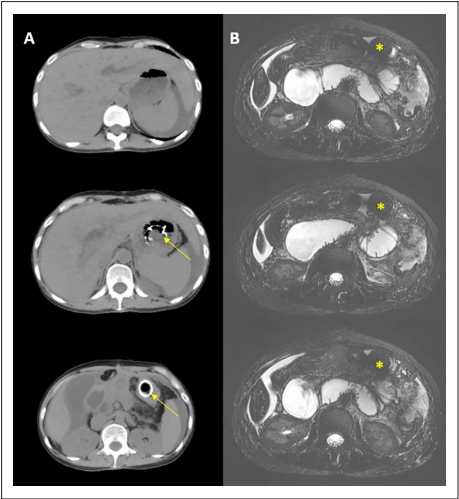
A computed tomography (CT) and a magnetic resonance imaging (MRI) scan showed bilateral intra-hepatic biliary radical dilatation (IHBRD) with a dilated bowel loop adjacent to the luminal SEMS (Figure 3). She quickly deteriorated due to worsening sepsis secondary to cholangitis and an emergency percutaneous transhepatic biliary drainage (PTBD) was performed to decompress the biliary system.
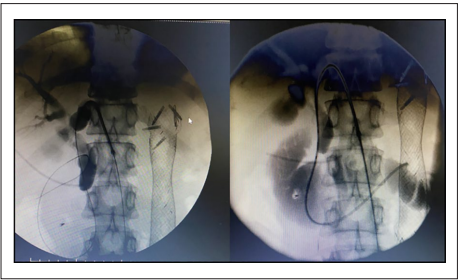
The cholangiogram showed a uniformly dilated common bile duct of 1 cm till the lower end (Figure 4). Upon placing the catheter, a reflux of bile along with bilious contents with high pressure was noticed. Gastroscopy showed luminal narrowing of the afferent loop which is likely blocked due to progression of tumor infiltration and partly due to the earlier placed luminal SEMS into the efferent loop.
This was endoscopically managed by inserting another 2.2 × 9 cm Wall flex (Boston Scientific) uncovered duodenal SEMS into the afferent loop (Figure 5). Although her jaundice and obstruction improved, she died 45 days later due to the progression of her terminal illness.
ELS is an extremely rare complication after gastro-jejunostomy surgery and is defined as mechanical obstruction of the efferent enteric jejunal limb leading to symptoms such as epigastric pain and recurrent bilious vomiting. This mechanical obstruction of the efferent limb can be due to an anastomotic stricture, malignancy, volvulus, intussusception, internal hernia, or abdominal adhesion after surgery.
ELS can occur with a surgically reconstructed foregut after a Whipple procedure, Billroth II gastrectomy or Roux-en-Y gastric bypass. Although mild or low-grade obstruction is often managed conservatively with nil-per-oral, nasogastric drainage and adequate hydration, patients with severe obstructive symptoms warrant a definitive intervention. There was a paradigm shift in the management of ALS or ELS from surgical to endoscopy-guided from the early 2000s due to the advancements in interventional endoscopy and accessories.
One of the earliest uses of luminal self-expanding metal stents to palliate malignant gastro-duodenal obstructions was witnessed in the early 1990s. Cancer recurrence after gastrojejunostomy leading to ALS or ELS depending on the site involved is an uncommon and late cause.
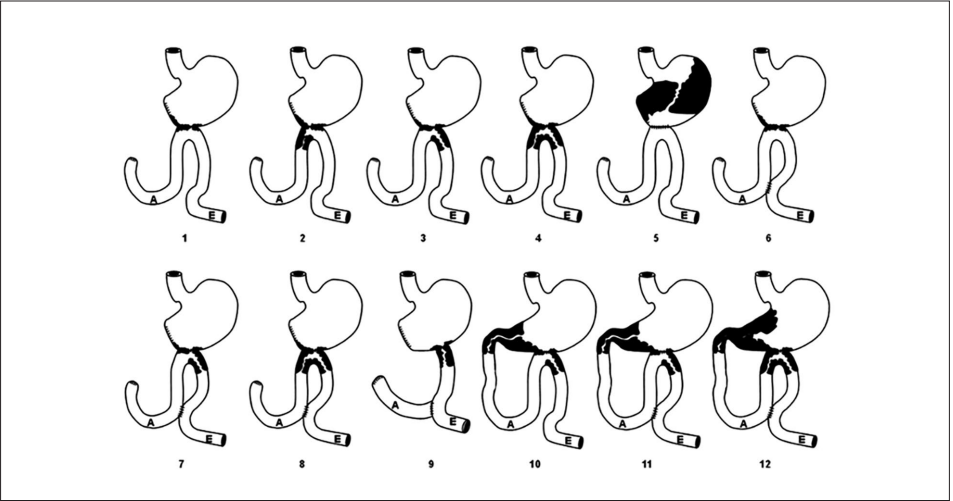
In a retrospective study of 39 patients with cancer recurrence after gastrojejunostomy by Song et al, demonstrated that luminal SEMS is a feasible and effective treatment strategy. They classified the types of recurrent malignant obstruction into 12 patterns which was referred to as the Song classification (Figure 6). The majority (62.5%) of their patients had a single luminal SEMS insertion pattern into the efferent loop and only 18.75% had upfront same-session dual SEMS insertion pattern into both loops due to possible obstruction at the anastomotic site or dual-loop syndrome.
The occurrence of ALS after efferent loop luminal SEMS is an extremely rare complication like which occurred in our patient, only 1 patient from the Song et al study developed this complication 10 days after the SEMS placement. A case report by Nakahara et al in 2016 also describes a similar complication of SEMS-induced ALS which was later treated by another luminal SEMS into the afferent loop.
Technical aspects of simultaneous stenting of both the loops in the same session are well described by Song et al. Most importantly, it is vital that a guidewire could be passed across into both the loops and deployment of the afferent loop stent to be followed by efferent loop stent deployment 0.5 to 1.0 cm above the upper level of the deployed former afferent loop stent. This technique can prevent stent-induced loop obstruction.
An additional complication of cholangitis along with stent-induced ALS is unfortunate in our patient and to the best of our knowledge has never been documented in the literature. A timely referral to a gastroenterologist experienced with managing surgically altered pathology might alter the course of a patient’s health early.
Often, the prognosis of these patients with recurrence of cancer is dismal. Song et al’s study documented that the median and mean survival periods were 89.0 and 118.3 days respectively while the patient treated by Nakahara et al survived for 5 months. Our patient had a progression of her metastatic terminal illness and survived for 1 month. Apart from luminal SEMS, other techniques include percutaneous drainage of the dilated loop, EUS-guided entero-enterostomy (EUS-EE) and drainage via double pigtail stent.
Endoscopic management of ALS or ELS is now considered to be the first line of and the treating endoscopist should possess good knowledge of the surgically reconstructed anatomy while performing these procedures. Consecutive loop obstruction development is a rare complication after luminal stenting and should be expected by the endoscopist. A close watch for these complications is necessary and timely interventions can improve the prognosis of these patients.
Nil
PKJ was involved in clinical case management, performed the endoscopic procedures and was responsible for the conceptualization of this case report. VP has written this case report with a review of the literature under the guidance of PKJ.
The author(s) declared no potential conflicts of interest with respect to the research, authorship, and/or publication of this article.
The author(s) received no financial support for the research, authorship, and/or publication of this article.
Institutional Review Board approval was not required.
Nil
Informed consent was obtained for this case report.
Vikas Pemmada: https://orcid.org/0000-0002-0202-9638
1. Tharavej C, Kattipatanapong W, Pungpapong S, Udomsawaengsup S, Kitisin K, Navicharern P. Outcome of endoscopic small-bore naso-jejunal tube stenting in early postoperative jejunal limb obstruction after gastrectomy. Surg Endosc. 2019;33(2):520-527.
2. Lee WY, Moon JS. Endoscopic treatment of efferent loop syndrome with insertion of double pigtail stent. World J Gastroenterol. 2013;19(41):7209-7212.
3. Lim D, Bain K, Sinha P. Successful endoscopic management of efferent loop syndrome after Billroth II distal gastrectomy. BMJ Case Rep. 2018;2018:bcr2018227167.
4. Song HY, Kim TH, Choi EK, et al. Metallic stent placement in patients with recurrent cancer after gastrojejunostomy. J Vasc Interv Radiol. 2007;18(12):1538-1546.
5. Zivari K, Waintraub DJ, Fazio RM, et al. 2183 endoscopic management of efferent loop syndrome using axios lumen-apposing metal stent. Am J Gastroenterol. 2019;114(1):S1222-S1223.
6. Truong S, Bohndorf V, Geller H, Schumpèlick V, Günther RW. Self-expanding metal stents for palliation of malignant gastric outlet obstruction. Endoscopy. 1992;24(5):433-435.
7. Maetani I, Ogawa S, Hoshi H, et al. Self-expanding metal stents for palliative treatment of malignant biliary and duodenal stenoses. Endoscopy. 1994;26(8):701-704.
8. Nakahara K, Sato Y, Suetani K, et al. Endoscopic Double Metallic Stenting in the afferent and efferent loops for malignant afferent loop obstruction with Billroth II anatomy. Clin Endosc. 2016;49(1):97-99.
9. Sato Y, Inaba Y, Murata S, et al. Percutaneous drainage for afferent limb syndrome and pancreatic fistula via the blind end of the jejunal limb after pancreatoduodenectomy or bile duct resection. J Vasc Interv Radiol. 2015;26(4):566-572.
10. Brewer Gutierrez OI, Irani SS, Ngamruengphong S, et al. Endoscopic ultrasound-guided entero-enterostomy for the treatment of afferent loop syndrome: a multicenter experience. Endoscopy. 2018;50(9):891-895.